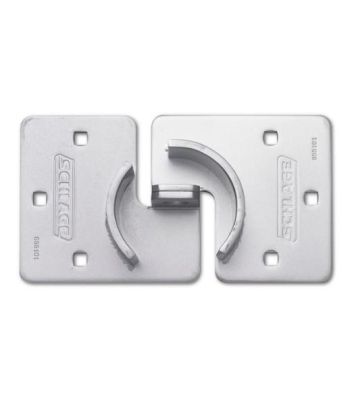
Padlocks Hasps
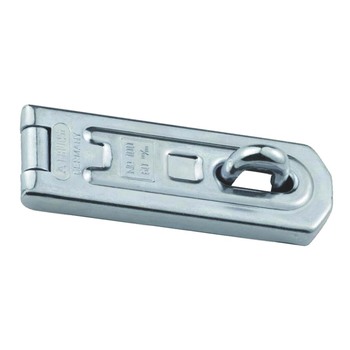
Padlock Hasps
A padlock is only as strong as what it's bolted to. That's a point that catches people out more often than it should — a decent padlock fitted to a thin pressed-steel hasp is still a job half done. The hasp is the part that takes the force when someone tries to kick a door, lever a gate, or attack a shed with a crowbar, and if it bends or pulls away from the fixing screws, the padlock itself is irrelevant.
The hasps here are specced for actual security work. ABUS single and multi-link models, Squire, CISA, Crompton — these are the names that come up when the spec sheet calls for a hasp rated to match a high security padlock. The multi-link ABUS 110 series is worth knowing about if the staple position isn't fixed — the extra articulation gives you more flexibility in how you align it on a door or gate frame. For heavier-duty applications, the Crompton 149 heavy hasp is built thick enough that it won't be the weak point in the installation.
The Kryptonite vehicle and van padlock hasp is a different application entirely — it's designed for van doors and rear security rather than sheds or gates, and it's worth specifying correctly rather than adapting something that wasn't designed for that job.
A few things that matter when you're choosing: fixing holes that are concealed when the hasp is closed are significantly harder to attack than exposed ones, so look for that design feature on anything going on an external door or outbuilding. For timber applications, the fixing screws are the next point of weakness — use coach bolts through the door rather than wood screws if the timber thickness allows it. And match the hasp security grade to the padlock — there's little point pairing a closed-shackle high security padlock with a light-duty hasp and staple.